
- Oxford, U.K.
Carl Benedikt Frey Keynote Speaker
- Founding Director, Future of Work Programme, Oxford Martin School, Oxford University
- Professor of AI & Work at the Oxford Internet Institute, Oxford University
- Author of 'How Progress Ends: Technology, Innovation, and the Fate of Nations‘ , shortlisted for the FT-Schroders Business Book of the Year 2025
Carl Benedikt Frey's Biography
Carl Benedikt Frey is the Dieter Schwartz Associate Professor of AI & Work at the Oxford Internet Institute. He is Director of the Future of Work Programme and Oxford Martin Citi Fellow at the Oxford Martin School. He is also a Fellow of Mansfield College, University of Oxford. Carl is regarded as a global thought leader and keynote speaker on the future of work and how technology is altering the workforce and our economies.
His book ‘How Progress Ends: Technology, Innovation, and the Fate of Nations‘ was published in September 2025 by Princeton University Press. It is on shortlist for the prestigious FT / Schroders Business Book of the Year 2025. In this important new book, he analyses the delicate balance between innovation and bureaucracy over time and why so many efforts fail – he also outlines the key lessons for nations, including the US, China and Europe.
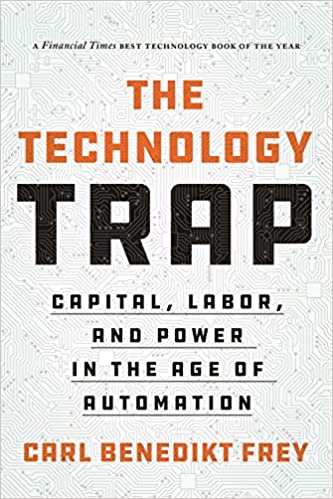
In his prior book, “The Technology Trap: Capital, Labor, and Power in the Age of Automation”, Carl examines the interplay of technological revolutions and the social and political shifts that accompany them. Taking the long-term view, he sees big innovations accompanied by periods of often severe disruption and pain for many, but eventually a more prosperous, equal society emerges. From the industrial revolution to digital and AI, he considers how political, financial and social capital are changed by the spread of technologies. ‘The Technology Trap’ was selected as a Financial Times Best Book of the Year 2019. The book also won Princeton University’s prestigious Richard A. Lester Prize. In the New York Times Book Review, David Byrne said it “the last great book I’ve read.”
In 2013, Carl co-authored “The Future of Employment: How Susceptible Are Jobs to Computerization”, estimating that 47% of jobs are at risk of automation. With over 12,000 citations, the study’s methodology has been used by President Barack Obama’s Council of Economic Advisors, the Bank of England, the World Bank, as well as the popular automation risk-prediction tool of the BBC. In 2019, the paper also featured on the Last Week Tonight Show with John Oliver.
Frey has served as an advisor and consultant to international organisations, think tanks, government, and business, including the G20, the OECD, the European Commission, the United Nations, and several Fortune 500 companies. He is also an op-ed contributor to the Financial Times, Foreign Affairs, Scientific American, and the Wall Street Journal, where he has written on the economics of artificial intelligence, the history of technology, the future of cities, and remote work.
In 2012, Carl became an Economics Associate of Nuffield College and Senior Fellow at the Institute for New Economic Thinking, both University of Oxford. He remains a Senior Fellow of the Department of Economic History at Lund University, and a Fellow of the Royal Society for the Encouragement of Arts, Manufactures and Commerce (RSA). In 2019, he joined the World Economic Forum’s Global Future Council on the New Economic Agenda, as well as the Bretton Woods Committee. And in 2020, he became a member of the Global Partnership on Artificial Intelligence (GPAI) – a multistakeholder initiative to guide the responsible development and use of AI, hosted by the OECD.
His academic work has featured in over 100 media outlets, including The Economist, New York Times, Time Magazine, the New Yorker, Le Monde, and Frankfurter Allgemeine Zeitung. In addition, he has frequently appeared international broadcast media such as CNN, BBC, PBS News Hour, Al Jazeera, and Sky News
Carl completed his PhD at the Max Planck Institute for Innovation and Competition in 2011.
Carl Benedikt Frey's Speaking Topics
-
Restarting Economic Growth: What Policies Do Governments Need to Implement?
Despite rapid innovation, growth has slowed. Productivity has disappointed not only in Europe, but also in China and the United States. What would it take to restart it? This talk draws lessons from history—especially the post-war decades, when growth surged worldwide—to outline practical levers for restarting growth.
-
The Geopolitics of Technology
AI has become the frontline of geopolitical rivalry. The U.S. and China are racing for dominance in AI—while others, from Europe to Japan, seek to catch up. This talk examines how technological power is reshaping the world economy and what smaller players can do to stay competitive.
-
AI and Economic Growth: Lessons from History to the Present
How long until AI shows up in the productivity numbers? Lessons from electricity and IT show payoffs lag breakthroughs: diffusion takes time and firms must reorganize. This talk maps the bottlenecks and the concrete levers business and government can pull to turn promise into broad-based growth.
-
Work in the Age of AI: Which Jobs, Which Skills?
Automation is reshaping work—but people remain central. The question is where we add the most value. This talk maps which tasks AI complements vs. replaces, and how businesses can build a resilient workforce.
-
The Future of Globalization: From Manufacturing to Services
Globalization is shifting from goods to services, from factories to platforms. AI and remote work enable “virtual migration” and new forms of global competition. This talk explores how these changes reshape comparative advantage of nations around the world.
-
AI and the Future of Cities
As AI automates high-end services, could New York and London face a Detroit-style shock? This talk identifies the likely winners and losers of the AI era—and distills what successful urban turnarounds got right
Why Book Carl Benedikt Frey as a speaker?
-
He is one of the world’s leading experts on the future of work, helping organisations understand how artificial intelligence, automation and technological change are reshaping economies, industries and labour markets.
-
He translates complex economic and technological trends into clear, evidence-based insights that help leaders navigate disruption and prepare for the opportunities and challenges ahead.
-
He is the author of influential research and bestselling books that have shaped global debates on automation, innovation and employment, with his work informing governments, international institutions and major businesses worldwide.
-
He combines deep historical perspective with cutting-edge analysis of AI and emerging technologies, offering audiences a unique understanding of how societies have adapted to previous technological revolutions and what that means for the future.
-
His keynotes help executives, policymakers and investors anticipate workforce transformation, understand the economic implications of AI and make more informed decisions in an era of rapid technological change.
Videos of Carl Benedikt Frey


Articles, Media & Podcasts
Books by Carl Benedikt Frey

Check Carl Benedikt Frey's speaking fees and availability
Discover other speakers